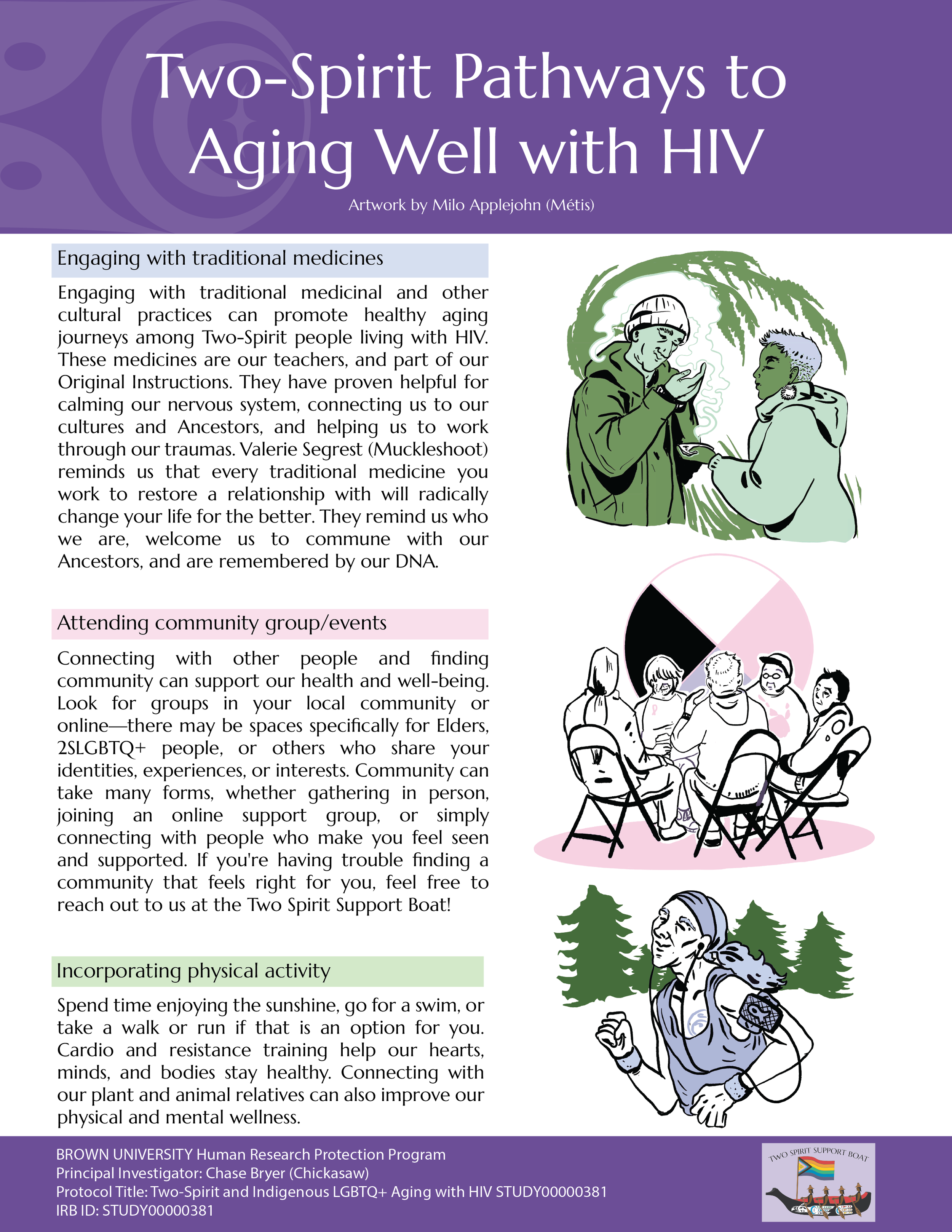
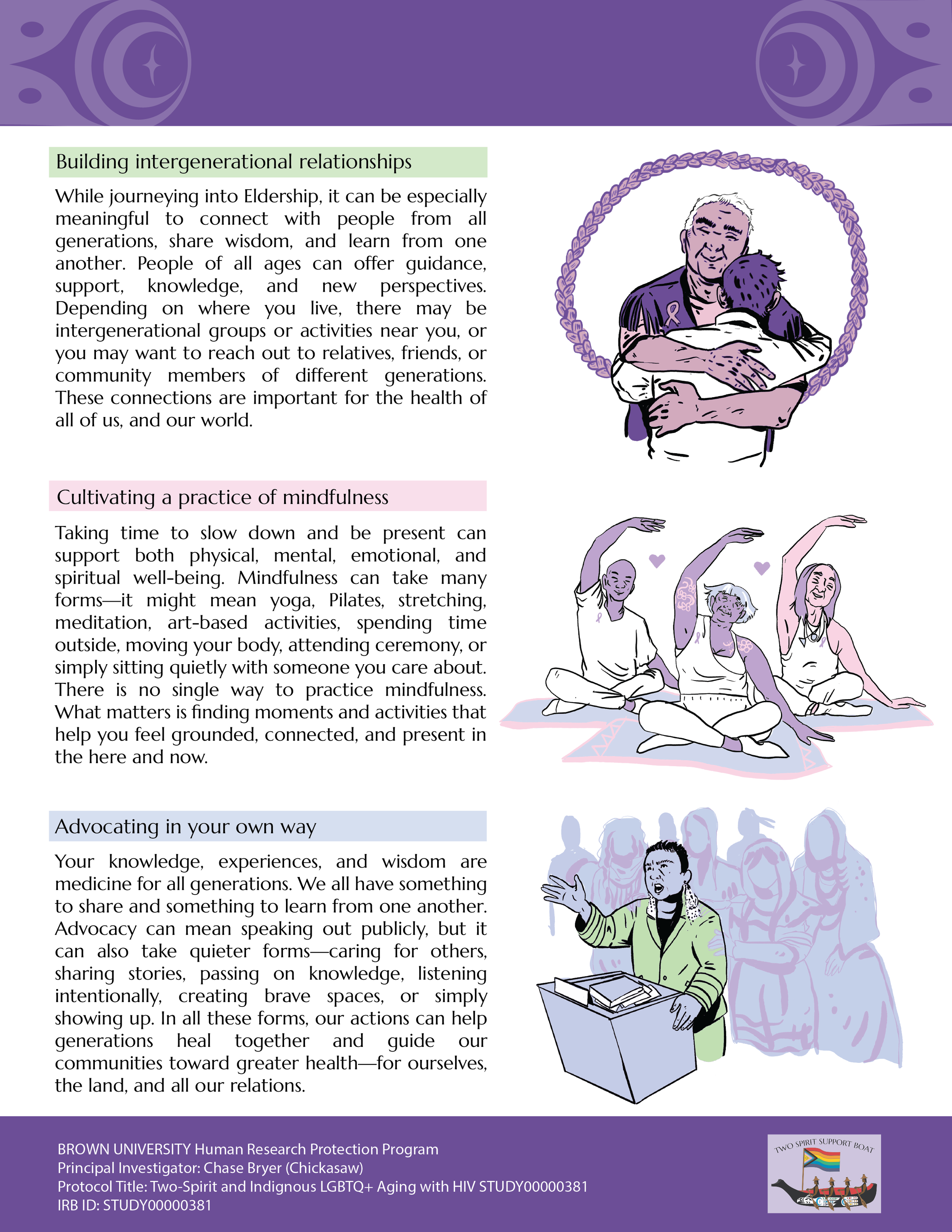
In 2024, Chase Bryer interviewed 15 Two Spirit and Indigenous LGBTQ+ Elders to explore what it means to age well with HIV. Chase asked about cultural and community supports, attitudes about aging, and passing knowledge down to the younger generations. In honor of World HIV/AIDS Day this year, we’ve sat down with Chase to talk about the project and to share the wisdom of community members that was gathered within the study.
Where did the idea for this project come from?
I’m Chickasaw, and I did my social work training at a long-term care facility working with older adults with HIV in St. Louis, Missouri. I came in with a lot of my own preconceived notions and stigmas around what it might mean to age with a chronic illness like HIV, and the residents within the long-term care setting defied those stereotypes. That made me curious about what it might mean to age at the intersection of Indigenous queer identity and HIV. The project was also fueled by learning about early models of “successful aging”—like one by Rowe and Kahn in 1997, for example—that were really heteronormative and based on colonial assumptions about what it means to age successfully. I wanted to trouble those ideas and build out more imaginings of what it looks like to age successfully from an Indigenous, Two Spirit perspective among community members aging with HIV.
As you reviewed the interviews, what finding stood out or surprised you?
The most surprising finding for me was the radical reimagining of HIV among participants. It came up again and again across interviews to the point where I eventually embedded a question in the interview guide that I would never have asked at first: “Would you imagine HIV as something that was actually useful in your life or served a vital purpose?” And all of the participants were like yes, it was a gift, it was a messenger, it was a blessing. The other important finding was the importance of integrating cultural practices with western HIV medicines. One participant talked about how whenever they took their ART in the mornings, they would smudge. And there was also a lot that came up around spirituality and how western care falls short in spiritual dimensions. One participant talked about their body being just the vehicle that carries their spirit. Their spirit is the driver of the vehicle, and they felt that the driver was often neglected in their health care.
In the larger population, because of stigma, people often mistakenly associate both aging and STI-diagnosis with decreased sexual expression. Were there people you spoke with who had instead found liberation post-diagnosis?
Participants talked about stigma and disclosure impacting intimate partnerships in later life. It was an obstacle for them in terms of having sex. But there were some participants who had a reawakening, once they were able to deconstruct that stigma for themselves. One participant said that if you looked at their aging trajectory from a colonial lens, they don't have a house or a wife or two kids or a dog or live in the suburbs. They're defying traditional western aging timelines, and they're able to forge success on their own terms in the aging process. That participant found a lot of liberation throughout their HIV journey.
How are you hoping this project might change our conversations around HIV and/or change the experiences of Indigenous people aging with HIV?
I'm hoping the project helps people reimagine what it means to live with HIV, going beyond narratives of deficit and despair to reposition HIV as something that could add meaning and purpose to one's life. That's what the participants articulated again and again: HIV had fundamentally reshaped their imaginations for later life in really interesting ways. So I’m hoping to reframe ideas about what it means to live with HIV and reconsider our models of aging care, thinking specifically about the necessity of culture, community, and access to traditional practices.
At the end of each interview, Chase asked, “What advice or words of wisdom would you give to younger generations of Indigenous 2S/LGBTQ+ people who are living with HIV?” Here are five of their responses:
I think the most important thing is to take care of yourself, is to love yourself. I know that it can be dark at first getting diagnosed and going through a downward spiral and just not taking care of yourself…Just take care of yourself and love yourself, and know that things will be all right…You're going to be okay.
I would say respect yourself, respect your body, respect your spirit, and once you have that respect, you can respect others. You can respect your partner and your community, but you have to respect yourself first.
“My dad used to say to me a lot: Just because you exist on this Earth doesn’t mean everybody has to value your existence. You’re going to have to be the one to educate and let them know what kind of existence you have….They may be in a community where there’s hardly anyone like yourself, so they don’t know how to interact with you. So the first thing you do is educate them—you’re going to say hi, do things like that, and yeah, they might have a demeanor that’s sort of like a wall, because they don’t really know what kind of person you are. But the more you understand, the more you educate, the more you stick with them, you start opening up, and they start breaking down those walls. And that’s very true, because so many times in my life, going to different border towns or cities to go shopping, and dressed as female, and walking through the doors of Walmart, I’d get, “Oh, well, what just walked in?” And I used to just think, “Oh my God, here we go again.” My dad would ask, “Why do you get so angry about it?” “What do you mean?” I’d say, “Just those stares that you get, it tears you down.” And he’d say, “No matter what, you shouldn’t let anything tear your spirit down. You need to understand and learn how to walk with pride and confidence. Because if you can’t gain that within yourself, you can never gain it from somebody else.
You know, I often say, “You don't want to D.I.Y. HIV and aging.” You don't. You see this push for apps and doing it on your own. I think it's just because there's so many people and there's so few doctors and health care providers. But I'm the opposite. I’m like, “I have this. I want to see a doctor. I want to see ten doctors.” I don't want to guess, I want to go talk to somebody who knows more than what I know. This is not the time to wing it. And so, for me, as I get older, it's about…getting as much support as you can. Just don’t go through this alone, that would be my biggest advice.
I think continuing to have a really honest relationship with your provider and then educating yourself and the community team members on your HIV status, and really honoring whether you're negative or positive, really making sure that's being honored. And if someone is positive, making sure we're honoring that sacredness, making sure that every human is sacred. Because we come from the earth, and we are below the heavens. We're in that middle space, and that is really sacred. Humanity is the blessing that we have. And I think, you know, with any illness—cancer, HIV, mental health illnesses, substance use—those things teach us a lot about who we are, and how sacred we are. Someone who's positive or someone who's on the LGBT spectrum, it's just a reminder, always, of how beautiful, how sacred we are. That’s what I've learned living with HIV—how to see the blessings within myself and make sure I'm honoring that. It's not a death sentence, you know? Like it or not, it's a blessing.…It’s a constant learning of how to honor yourself. And that's for everybody, whether you're ill or not. But with HIV there's a little bit of a magnifier on it.
Want to know more about Aging Well With HIV? We’re collaborating with Chase to create an Aging Well with HIV toolkit in 2027. Keep an eye out!
This study (Two-Spirit and Indigenous LGBTQ+ Aging with HIV) was approved by Brown University Human Research Protection Program IRB ID: STUDY00000381. To hear more, watch Chase’s presentation with the Mayo Clinic.