Breaking Down Barriers: The Power of Incentives in STI, HIV, and HCV Care
At The Raven Collective, we believe that empathy, community connection, and accessible resources are at the heart of public health. But how do we reach community members who still face systemic barriers to getting the care they need? One increasingly vital tool is incentives.
To better understand how this approach is being utilized in the field, The Raven Collective collaborated with the National Association of County & City Health Officials (NACCHO) to conduct an organizational-level survey between March and April 2026. We reached out to 94 local health departments and 34 Indian/Tribal health agencies to explore how incentives are currently being considered and used to support STI, HIV, and HCV testing, treatment, and care.
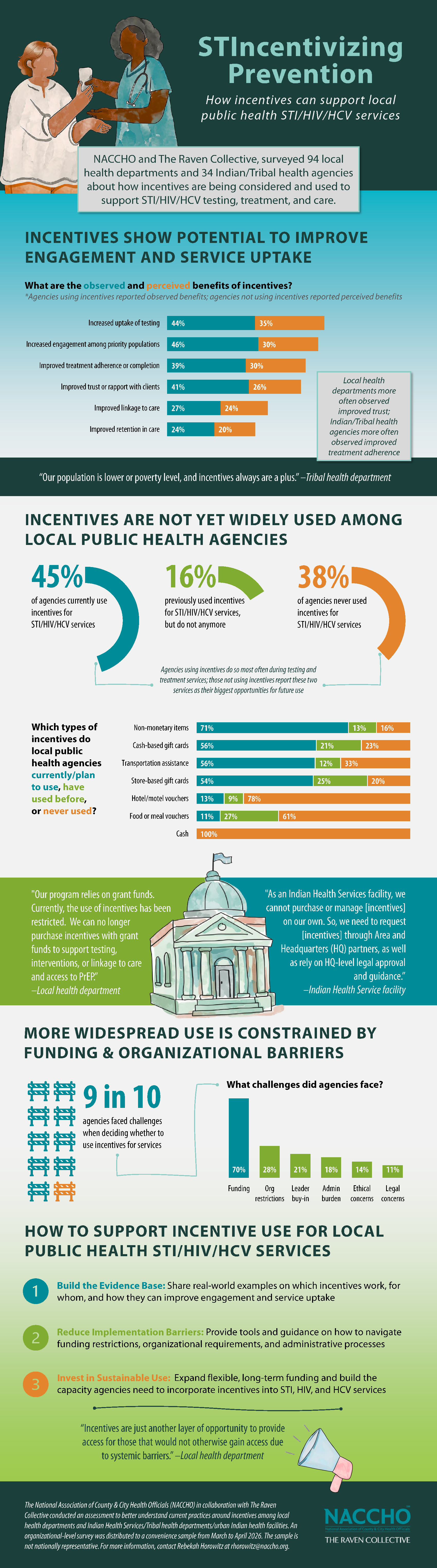
The findings, summarized in the STIncentivizing Prevention Infographic, reveal the immense potential of incentives to improve health outcomes, alongside the significant structural hurdles our public health partners face in implementing them.
The Real-World Benefits of Incentives
When local public health agencies use incentives, the positive impacts on community health are measurable and profound. The survey found that incentives can significantly improve both engagement and service uptake.
Agencies using incentives reported several key observed benefits:
Increased engagement among priority populations was observed by 46% of agencies.
Increased uptake of testing was observed by 44% of agencies.
Improved trust or rapport with clients was observed by 41% of agencies.
Improved treatment adherence or completion was observed by 39% of agencies.
Improved linkage to care was observed by 27% of agencies.
Improved retention in care was observed by 24% of agencies.
Interestingly, local health departments most often reported improved trust, while Indian and Tribal health agencies most often reported improved treatment adherence. As one Tribal health department noted, "Our population is lower or poverty level, and incentives always are a plus".
How Are Incentives Being Used Today?
Despite the clear benefits to our relatives and communities, incentives are not yet universally adopted. The survey found that:
45% of agencies currently use incentives for STI, HIV, and HCV services.
16% used them previously for these services but no longer do.
38% of agencies have never used incentives for STI, HIV, and HCV services.
For agencies that do use them, they most often deploy incentives during testing and treatment services. Furthermore, agencies that don't currently use incentives identified testing and treatment as their biggest opportunities for future use.
When asked what types of incentives agencies currently use, plan to use, or have used before, the top choices included:
Non-monetary items (71%).
Cash-based gift cards (56%).
Transportation assistance (56%).
Store-based gift cards (54%).
Food or meal vouchers, hotel/motel vouchers, and cash were also reported, though cash was the least utilized option.
Navigating Systemic Challenges
If the benefits are so clear, why aren't more agencies utilizing incentives? In reality, funding and organizational barriers heavily constrain broader use. A staggering 9 in 10 agencies faced challenges when deciding whether to use incentives for services.
The top challenges reported by agencies include:
Funding restrictions (70%).
Organizational restrictions (28%).
Lack of leader buy-in (21%).
Administrative burden (18%).
Ethical concerns (14%).
Legal concerns (11%).
These barriers can severely limit community health initiatives. One local health department shared the frustrating reality of restricted funding: "Our program relies on grant funds. Currently, the use of incentives has been restricted. We can no longer purchase incentives with grant funds to support testing, interventions, or linkage to care and access to PrEP".
For our Indian Health Service (IHS) facilities, the administrative and legal hurdles are particularly complex. An IHS facility explained, "As an Indian Health Services facility, we cannot purchase or manage [incentives] on our own. So, we need to request [incentives] through Area and Headquarters (HQ) partners, as well as rely on HQ-level legal approval and guidance".
Charting a Path Forward
To build stronger, more equitable public health pathways, we must support local and Tribal agencies as they implement these programs. The survey outlines three vital steps to better support incentive use for local public health STI, HIV, and HCV services:
Build the Evidence Base: We need to share real-world examples of which incentives work, for whom they work, and how they successfully improve engagement and service uptake.
Reduce Implementation Barriers: We must provide tools and guidance to help agencies navigate funding restrictions, organizational requirements, and administrative processes.
Invest in Sustainable Use: We must advocate to expand flexible, long-term funding and build the capacity agencies need to incorporate incentives into STI, HIV, and HCV services.
Ultimately, this work is about equity. It's about removing the hurdles that prevent people from receiving the care they deserve. As one local health department summarized, "Incentives are just another layer of opportunity to provide access for those that would not otherwise gain access due to systemic barriers.”
(Note: The survey sample was a convenience sample distributed to agencies and is not nationally representative. For more information, contact Rebekah Horowitz at rhorowitz@naccho.org.)